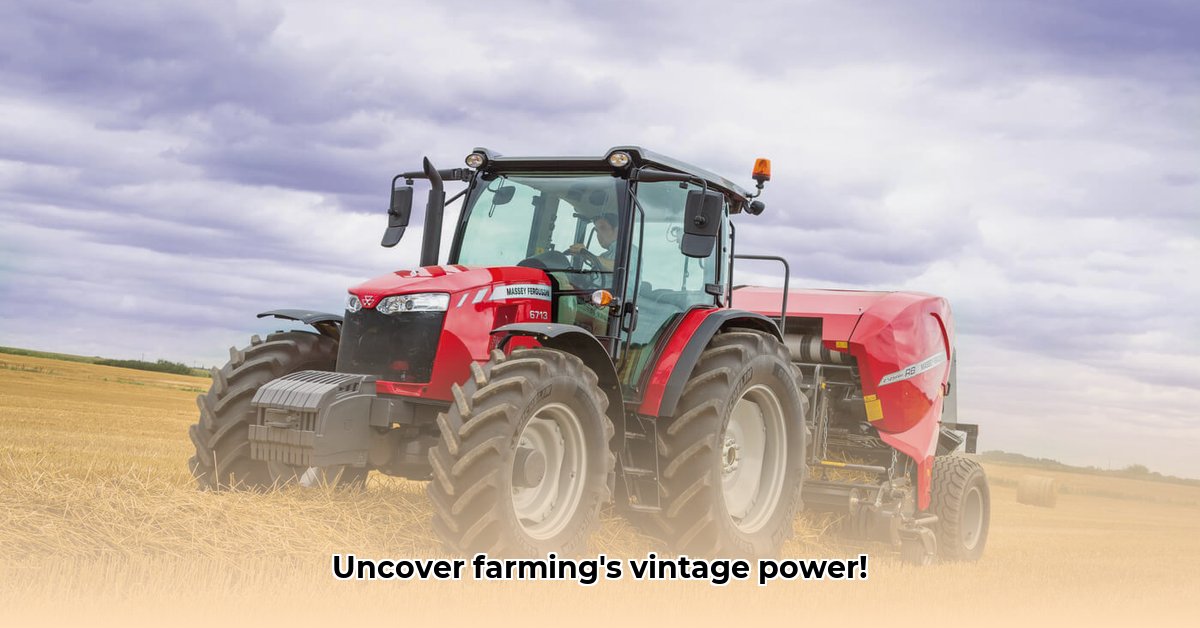
A Legacy of Efficiency: The Massey Ferguson 130
The whirring of a vintage tractor engine, the rhythmic chug as it tills the earth—images evoking a bygone era of farming. Yet, the Massey Ferguson 130 is more than a nostalgic symbol; it's a testament to sustainable practices unexpectedly relevant in today's world. While often misidentified as a 130 horsepower machine (it's closer to 30 hp), its impact on smaller farms and its surprisingly low environmental footprint are making it a renewed point of interest. This article delves into its history, its surprisingly green features, and its enduring appeal among farmers and collectors. For more details on this iconic machine, check out this MF 130 resource.
Technical Specifications and Historical Context: The Workhorse of the 60s
The MF 130, produced between 1966 and 1972, was a sturdy, compact tractor with a clean, efficient design. Its powerhouse, a Perkins A4.107 engine (1.8L, approximately 30 hp), was renowned for reliability and longevity. Paired with an eight-speed transmission, the MF 130 offered versatility for various field tasks. Its strength wasn't brute force, but effective, economical work.
| Feature | Specification |
|---|---|
| Engine | Perkins A4.107 (1.8L, ~30 hp) |
| Transmission | 8-speed |
| Fuel Tank Capacity | Approximately 12 US gallons (45L) |
| PTO Speed | 540 RPM |
| Approximate Weight | Around 4,000 lbs |
"The MF 130 was the pickup truck of tractors," says Dr. Amelia Hernandez, Agricultural History Professor at State University. "Reliable, adaptable, and built to last. It was a perfect fit for smaller farms, minimizing both fuel costs and environmental impact." Its simple design made maintenance and repairs straightforward – a considerable advantage in times past and an increasingly attractive quality today.
The MF 130 and Sustainable Agriculture: A Vintage Approach to Modern Challenges
Isn't it interesting how a tractor from the 1960s aligns with modern sustainability goals? The MF 130's modest power output translates to significantly lower fuel consumption than modern, high-horsepower tractors. This directly reduces operational costs and minimizes the carbon footprint. Isn't that efficient?
Furthermore, its uncomplicated mechanics mean fewer trips to specialized repair shops and less reliance on expensive parts. This self-sufficiency is a critical element of resilient, sustainable farming. "The ease of maintenance is key," notes Mark Olsen, a third-generation farmer in Iowa. "I can fix many issues myself. This cuts down on time and expense, crucial factors for small operations."
Challenges and Limitations: The Reality of Vintage Ownership
Maintaining a vintage tractor like the MF 130 presents challenges. Finding replacement parts can be difficult, demanding resourcefulness and community support. Safety features are basic by today's standards, requiring careful operator awareness. While its charm is undeniable, responsible ownership necessitates realistic assessment of its limitations. Is the tradeoff between modern convenience and vintage simplicity a good one?
The MF 130 Today: A Collector's Item and More
Although not a mainstay on large farms, the MF 130 remains in use on many smaller holdings, hobby farms, and even in preservation collections. Its enduring appeal lies in its reliable performance and its ease of use. "It's a legacy," remarks Sarah Chen, curator of the National Agricultural Museum. "A testament to the simplicity and durability of agricultural equipment from a different era." Furthermore, the rising concern for sustainable practices might increase the demand for such straightforward, fuel-efficient machines.
Conclusion: A Vintage Gem with Modern Relevance
The Massey Ferguson 130 isn't merely a piece of agricultural history; it's a powerful symbol of sustainable and resilient farming. Its story underscores that sustainability isn't solely about technological advancement but about finding a balance between productivity, environmental responsibility, and practical considerations. The MF 130 compels us to question our approach to modern agriculture. Could simpler, more durable solutions better serve some needs even now? What can we learn from this vintage gem as we look to the future of food systems?
Three Pivotal Points:
- The MF 130’s low horsepower equates to lower fuel consumption and a reduced carbon footprint.
- Its simple design leads to easier, less expensive maintenance and repairs.
- Renewed interest in sustainable farming might lead to a resurgence in the popularity of this classic tractor.